(Tsaalgrend)…CR 2…植物类
Strange,translucent gas bladders carry this tangle of thorny,purple vines and clumps of mold through the air.
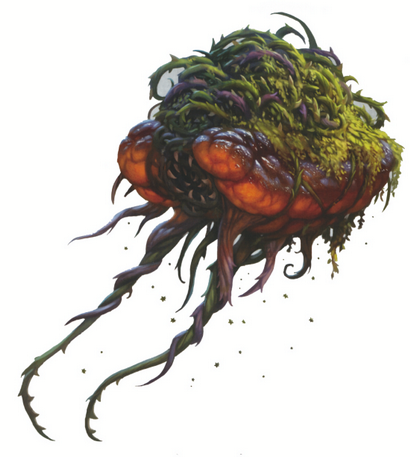
Tsaalgrend CR 2
Source Bestiary 5 pg. 251, Pathfinder #85:Fires of Creation pg. 88
XP 600
N Small plant
先攻 +2;感官 darkvision 60 尺,low–light vision;察觉 +4
防御
AC 14,touch 13,flat–footed 12(+2 敏捷,+1 natural,+1 size)
HP 19(3d8+6)
强韧 +5, 反射 +3, 意志 +1
免疫 plant traits;抗性 id 5,electricity 5
弱点 light blindness,vulnerable to fire
进攻
速度 10 尺,climb 10 尺,fly 40 尺(poor)
近战 bite +5(1d4+2 plus grab),2 tendrils +3(1d4+1 plus grab)
特殊攻击 grab(Medium),spores
属性
力量 15, 敏捷 15, 体质 15, 智力 3, 感知 10, 魅力 8
Base Atk +2;CMB +3;CMD 15(17 vs. trip)
技能 Climb +10,Fly +5,察觉 +4
语言 spore communication
生态
环境 any underground
组织 solitary,pair,cluster(3–6),or pod(7–20)
宝物 none
特殊能力
Spores(Ex)As a standard action,a tsaalgrend can release a cloud of toxic spores in a 10–foot–radius spread. Each living creature within this area must succeed at a DC 13 Fortitude save or become paralyzed with fear as it vividly hallucinates for 1d4 rounds. A creature that successfully saves against this effect is immune to the same tsaalgrend's spores for 24 hours. This is a mind–affecting fear and paralysis effect. The save DC is Constitution–based.
A tsaalgrend is a predatory creature resembling a tangle of sturdy vines with jagged purple thorns. Its coloration is mottled with brown,green,and yellow mold patches that f lake and fall as the creature writhes through the air. The tsaalgrend's vines barely conceal two translucent,gas–filled sacks that act as balloons,enabling it to f loat along above the ground. Two longer vines stretch from the creature's center,allowing the tsaalgrend to snare its prey. An opening filled with rows of spiky thorns,positioned on the creature's underside,serves as the creature's mouth. This orifice constantly emits a wet,rancid stench and a wheezing sigh as warm gas escapes from its f loatation chambers.
Tsaalgrends are complex,ambulatory fungi,but also symbiotically support a multitude of other molds,fungi,mosses,and epiphytes. The most powerful mold growing within tsaalgrends produces potent,hallucinogenic black spores. Tsaalgrends mainly use these f ine spores for hunting,and they are capable of ejecting spores in a wide area to stun prey. Any creature that breathes in the spores is immediately subject to an overwhelming terror response as its mind f loods with primal,animalistic fears. The victim's breathing becomes quick and shallow,its heart rate rises dramatically,and nearby sounds become dull over the rush of blood in its ears. The creature's mind begs to f lee,but its muscles simply seize tight. Most victims f ind this experience maddening enough that their frustration and panic heighten the actual chemical effects of the tsaalgrends' spores.
Daring alchemists occasionally hunt and trap tsaalgrends with the intention of harvesting the black spores from living specimens and using them to fabricate new and potent inhaled poisons. Securing a living tsaalgrend is important to the process,for the spores lose potency soon after they are released,making storage for later use impractical. Such alchemists often run afoul of fungus–focused druids,who commune with and protect these unusual plants.
Tsaalgrends display a limited intelligence—easily on par with apes— and can overcome simple puzzles and challenges. They communicate basic concepts with each other through the deliberate transfer of spores. These bouts of communication involve bursts of various colors and scents,granting tsaalgrends with large and more varied symbiotic colonies something akin to leadership roles. Most often,tsaalgrends "speak" to each other to coordinate hunting efforts. The plants also respond to some spoken language,though they lack a well–developed sense of hearing and show diff iculty differentiating any but the simplest words and phrases. Several distinct patches of stubby 1– or 2–inch growths track light and movement,essentially serving as eyes.
A tsaalgrend typically grows to be over 3 feet long,and weighs about 40 pounds.